
The facts about fats
-
in Blogs

Last night I presented Step 5 of the 12 Steps to Wholesome Nutrition course in Johannesburg. It was all about fats - the good bad and ugly ones….. I explored a number of fat myths with the class, starting with ‘fat will make you fat’ and finishing with ‘fat will make you skinny’! That really is the extent to which many people’s thinking has changed in recent years and in many ways, it’s good because we shouldn’t be afraid of fats, but in other ways, it’s not so good, because we need to be deeply respectful of them.
I am, of course, talking about fat quality. We can’t just open ourselves up to eating all sorts of fats and in high quantities - it’s very risky for our health. The prevailing dietetic guidelines suggest that around 30 per cent of our calories should come from fat and 10 per cent should be saturated fats. I would certainly drift upwards from the 30 per cent overall figure in my dietary recommendations for some people, but I wouldn’t deviate too far from the 10 per cent coming from saturated fats. Many people have genes that show they don’t process saturated fats too well, especially when it comes to weight management. So, although many people experience improved body composition by following a Banting diet, many do not. And some of the people benefiting from a Banting approach may simply be doing so because they have taken poor quality carbs out of their diets.
Saturated fat is vital for bodily functions - it forms a large part of the membrane of every single cell in our body and it is a slow-burn energy producing molecule. But it is also pro-inflammatory if out of balance with the unsaturated fats and it is this piece of information that is vital for long term health. Inflammation has been studied a lot over the past decade and it has now been linked to pretty much every degenerative disease experienced by humans; from rheumatic and autoimmune disorders, through heart disease, to neurodegeneration.
Unsaturated oils come predominately from seeds and nuts, plus they are present in smaller amounts in certain vegetables and unprocessed grains. Olive oil, for example, is high in mono-unsaturated fatty acids, whereas flax, hemp and sunflower seed oils are high in poly-unsaturated fatty acids. It is these fats that we should be eating more of, but in their fresh form, either as nuts and seeds, or as cold-pressed oils. The media abounds with information on the benefits of unsaturated fats, but the information can become very misleading. Oils such as sunflower, corn and canola oil (and often the margarines made from them) may be listed as ‘heart healthy’. However, how many of these particular oils have you seen in a cold-pressed form and perhaps even organic and GM-free? If they are in clear plastic bottles, with a distant expiry date, they are heat-pressed. I’ve written on this subject in Chapter 3 of Wholesome Nutrition, but needless to say, you don’t want to go near them. We need to be respectful and somewhat limiting of our saturated fats, but we need to strictly avoid man-made fats - our health depends on it. You may have heard of ‘trans fats’ - they are molecules that are formed from heating and pressurising these otherwise healthy fats and they are of a shape that will cause disruption to the cell membranes (which should only contain saturated and unsaturated oils plus a bit of cholesterol). They are in processed oils, all margarines (despite their label claims), most processed food items, including snack products, plus you can make them yourself when you over-heat your olive or coconut oils.
With regards to this last point, it is important to be aware of smoke points of various oils when you’re cooking - some oils (including flax and hemp) should not be heated at all (just use over your salads), others like olive and coconut oil can be heated to a moderate temperature, whereas only certain ones, such as ghee and avocado oil, can be heated to a high temperature. Check out this resource on smoke points, but please do not use the refined and semirefined oils listed. Read here.
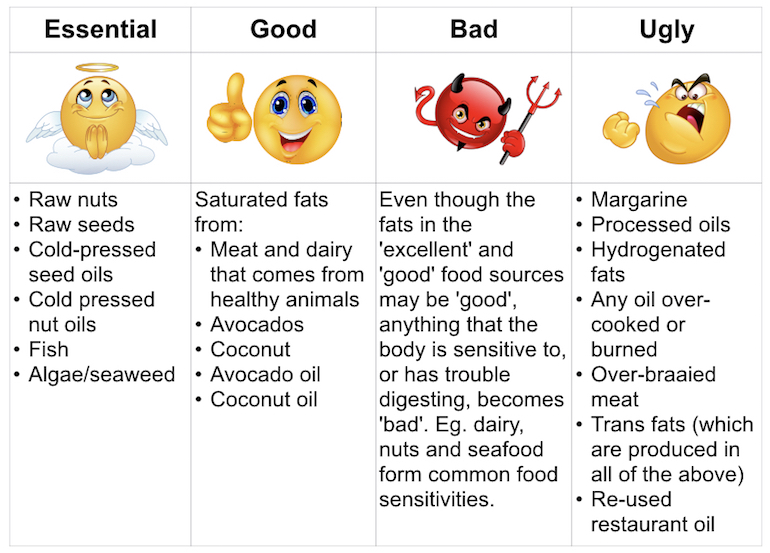
To round off on our discussion of good, bad and ugly oils, I shall leave you with this table - print it out, stick it on your fridge and look at it till you know this stuff - it's important...
If you would like additional information on omega oils, especially omega 3’s and 6’s, please check out my article in Natural Medicine magazine.